

The Dusk Moor
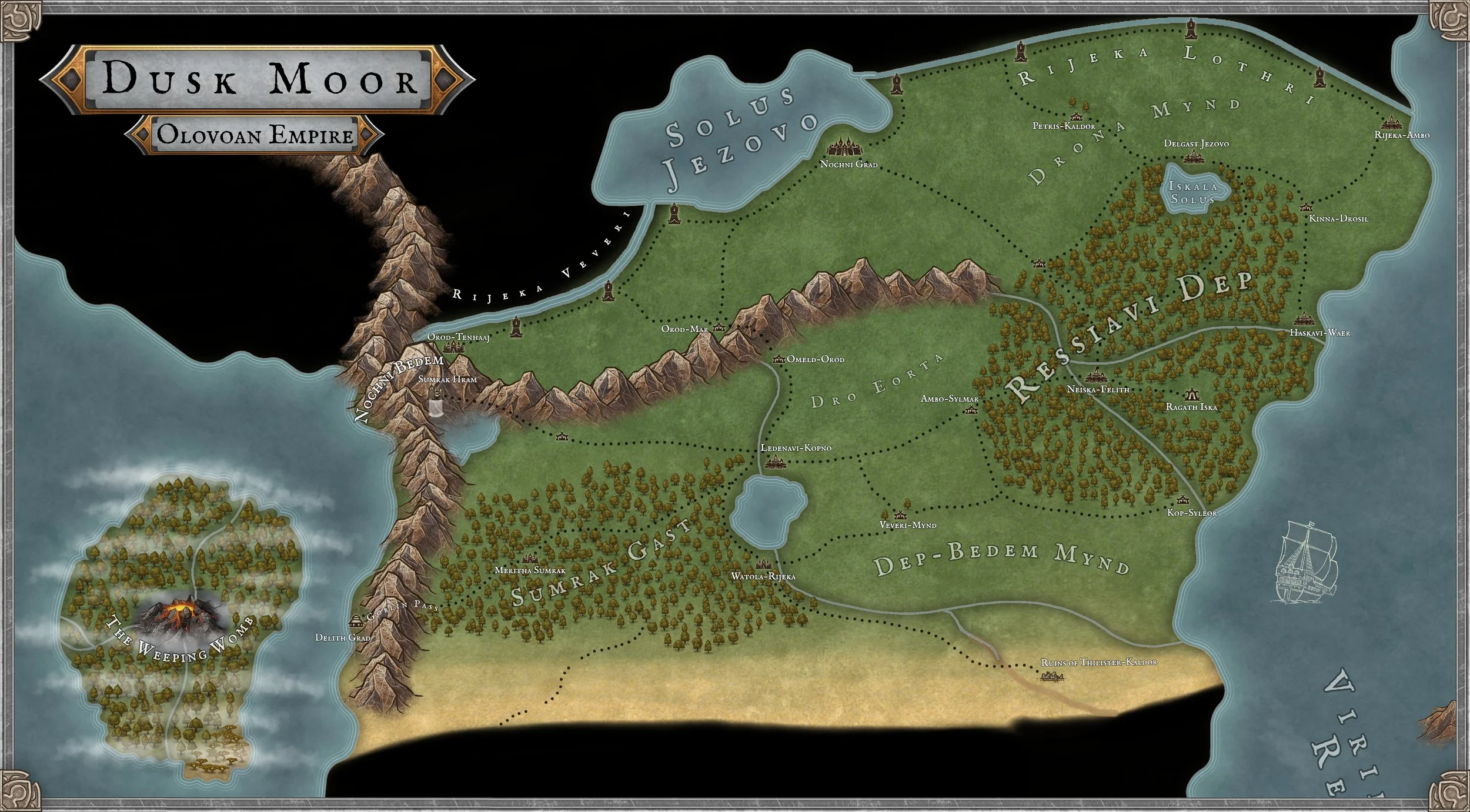
Here, twilight is not a passing hour but lingers, veiled across the land like a half-spoken prayer. The vows of a thousand souls lift up the glory of the Dusk Father, Artar, as his people go about their lives in reverance. Somewhere in the Ressiavi Dep, a scream carries on the wind, and plants curl towards the warmth of blood spilled in memory of it’s holder. On one night a year, the fields light up with the glow of the stars, echoing the prayers of those who know their power. To the West, light pollutes the air from the constant fires of the Weeping Womb, spitting magma and earthen protectors from it’s core to the ashen skies and lands below.
WORK IN PROGRESS…

Geography and Climate
Home to the cryptic Dusk Elves, the Dusk Moor consists primarily of uncultivated dark green grasslands of low-growing vegitation broken by forests, lakes, rivers and rugged mountain terrain.
The primary landmark is Nochni Bedem, a large dormant volcano whose slopes and chained mountain ranges divide much of the surrounding landscape. One major river originates from its foothill, Rijeka Veveri which bleeds into a large lake - Solus Jezovo - out of which a new river extends towards the sea called Rijeka Lothri. These waterways form a natural border with the sister kingdom of Lun, they supply fertile floodplains and sustain numerous settlements that line near and on their banks.
The climate is cool and temperate throughout most of the year. Summers are mild rather then hot, while winters are cold but rarely severe outside higher elevations. Persistent moisture from rivers, lakes and coastal winds create frequent fogbanks and heavy morning dew. Rainfall is common, though usually light and prolonged.

Ecology and Enviroment
The Dusk Moor is a biologically diverse region characterised by perpetual twilight, extensive waterways, and persistent magical influence. Despite frequent external perceptions of the area as dim, barren, or inhospitable, it supports a wide range of ecosystems adapted to chronically low-light conditions. Ecological development across the region has been strongly shaped by limited solar exposure, and long-term arcane effects, resulting in flora and fauna distinct from those found elsewhere on Sesmi.
The Open Moorlands constitute the majority of the Dusk Moor and consist of rolling grasslands dominated by hardy, moisture-tolerant vegetation. Plant life in these areas tends to grow vertically and competitively for space rather than sunlight, reflecting the reduced importance of direct illumination. Large grazing populations play a significant role in shaping the landscape through migration and feeding patterns, creating natural pathways that influence both predator movement and humanoid travel.
A defining characteristic of the Dusk Moor’s ecology is the influence of the Veil, which affects biological rhythms and evolutionary traits across the region. Many species exhibit crepuscular behaviour patterns, with peak activity occurring during transitional periods resembling dawn and dusk, despite the absence of a true day-night cycle. Reduced sunlight has also influenced pigmentation, with dark and muted tones predominating across both flora and fauna. In some cases, bioluminescent traits have evolved as adaptive mechanisms for pollination, navigation, or communication in low-light conditions.
Enviromental Hazards
The Dusk Moor presents a range of environmental hazards that vary significantly between its ecological zones, with the most severe dangers concentrated in areas influenced by magical corruption or geological instability. While much of the region is habitable under normal conditions, prolonged exposure to certain environments or phenomena can result in physiological, psychological, or magical harm.
Overview
The Moor exists benieth a phenomenon known as the Veil. According to local belief, the overwatch of the Father shrouds the lands.
The atmosphere above the region contains immense concentration of fine ash, airborne spores and magical particulates released over the centuries by the forests and volcanic terrain. Together these particles refract sunlight before it reaches the ground, muting daylight into perpetual twilight. Dawn and dusk remain visible, but neither fully transitions into bright day. Even at midday, the landscape resembles late evening. This dusk has profoundly shaped local pant and animal life to adapt to low-light conditions.
Thought often percieved as gloomy, the Dusk Moor is remarkably alive. Open low-grown flora support vast herds of hrazing animals while ancient forests dominate the south. Strange glowing flora are common throughout the countryside. The region contains notable anomalies, a corrupted necromantic forest and an isolated island warped by reality.
The Ressiavi Dep
A vast necrotic forest where the effects of dark magic have permenently altered the landscape. Many legends originate from this particular forest.
Unnaturally dim even by Dusk Moor standards, massive Petrivit trees form dense canopies that block much of the already weakened sunlight. Their twisted roots erupt from the earth like skeletal fingers, making traversal typically slow and exhausting.
The forest displays widespread signs of corruption. Vegetation appears diseased despite remaining healthy, many plants possess defensive mutations, wildlife often exhibits physical shriven decay without suffering impairment and strange bioluminescent growths illuminate parts of the undergrowth.
The deeper one travels into the Ressiavi Dep, the less natural the eviroment becomes. Sounds, visibility, mental stability all pose a risk to prolonged exposure.
The Weeping Womb
Far from the mainland lies an island known as the Weeping Womb.
Unlike any other region in the Dusk Moor, the island appears less like a natural landmass and more like an open wound upon the world itself.
The soil is extraordinarily fertile and continuously generates new forms of life. Dense mist shrouds much of the island, while strange cries are frequently heard drifting across the surrounding waters.
No ordinary animals inhabit the Weeping Womb, instead it is guarded by entities known as Fragmentals. They are golem-like beings believed to have emerged directly as a result of the wound itself. These creatures act with singular purpose, instinctively defending the island from intrusion.
Scholarly consensus theorizes that the island is a physical manifestation of damage inflicted upon the world. The land appears to be attempting to heal itself, continuously producing new life in response to injury that never fully closed.

Indigenous Inhabitants
The Dusk Moor is home primarily to the Dusk Elves, a long-lived elven people whose civilization has evolved beneath the perpetual twilight. While outsiders often perceive them as grim or intimidating due to their dark appearance and sombre architecture, the reality is quite different. Dusk Elven society values patience, reflection, hospitality, and communal responsibility above displays of power or wealth. The Dusk Elves organize themselves through a blend of feudal administration and religious authority.
Centuries of life beneath a dim sky have fostered a culture that moves at a measured pace. Dusk Elves are rarely hurried, preferring careful consideration over impulsive action. Their settlements are typically built from dark stone and timber gathered from the surrounding forests, with warm communal spaces serving as the heart of both village and city life. Faith in Artar, the Dusk Father forms a cornerstone of Dusk Elven life, shaping many of their customs and attitudes towards life, death, passage of time and the threshold between.
